






Reliable 1-Wire Networks
This guide provides a few practical tips on how to build reliable 1-Wire measurement networks, for example in home automation or distributed sensor systems.
Through many years of working with 1-Wire systems we have seen and analyzed a wide range of installations. In practice it turns out that stable and reliable 1-Wire networks can be achieved without much effort when suitable hardware is used and a few basic principles are followed.
The internet contains many different approaches and recommendations for improving the reliability of 1-Wire networks. Some of these measures can indeed help in certain situations, but they often do not address the underlying cause of the problem.
Background
The 1-Wire protocol was originally designed to allow different components on a circuit board to communicate with each other, for example devices connected to a microcontroller. In such applications the communication distances are typically very short.
Today, however, 1-Wire is frequently used in much larger installations, such as building automation systems or sensor networks with many devices and long cable runs.
A common misconception is that the reliability of a 1-Wire network mainly depends on the chosen network topology or on adding components such as capacitors, amplifiers or similar hardware. While such measures may improve certain situations, they usually do not address the fundamental cause of communication problems.
Another approach sometimes used is to split larger installations into several smaller 1-Wire networks. In certain situations this can be useful, but it also increases hardware and installation complexity because additional masters, power supplies and distribution hardware are required.
1-Wire Masters for Network Applications
Many commonly used 1-Wire adapters are based on hardware interfaces from Maxim Integrated, for example the DS9490R or DS9097U. These adapters were originally designed for applications such as eCash systems, handheld measurement devices or data logger programming tools.
In these scenarios the adapters work reliably. However, when they are used in larger 1-Wire networks with longer cable runs and many devices, stability issues may occur as the network grows. The reason lies in the characteristics of the 1-Wire protocol and the relatively simple implementation of these standard interfaces.
Adapters specifically designed for larger 1-Wire installations can offer advantages in such situations. One example is the Link adapter family from iButtonLink. These adapters are available for different host interfaces and can be used on Windows, Linux and macOS using the original drivers.
The Link – A Smarter Approach
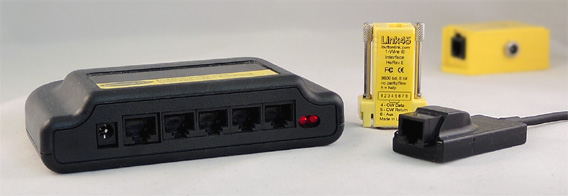
The key difference compared to conventional 1-Wire masters is that adapters of the Link family do not rely on a simple static 1-Wire interface. Instead, the actual 1-Wire communication is handled by a microcontroller inside the adapter.
This architecture allows the communication parameters to be dynamically adapted to the characteristics of the connected network. While standard adapters operate with fixed timings, the Link adapters can continuously adjust important timing parameters of the 1-Wire protocol.
In installations with longer cables or larger numbers of devices, where simple adapters may start to struggle, optimized algorithms help maintain stable communication — even in networks that go well beyond the original design scope of the 1-Wire protocol.
From the user's perspective these optimizations remain completely transparent. To the software the adapter behaves like a conventional 1-Wire interface, which means applications developed for standard adapters can usually be used without modification.
In addition, Link adapters include further hardware features designed to reduce disturbances originating from the 1-Wire network or the host system itself.
Choosing the Right Cable
Besides the 1-Wire master, the type of cable used also plays an important role when building reliable 1-Wire networks.
A widespread misconception is that telephone cables or flat ribbon cables are suitable for the 1-Wire bus. These cables typically provide neither shielding nor twisted wire pairs and are therefore poorly suited for larger installations.
Because of the name "1-Wire", it is often assumed that very thin cables with only a few conductors are sufficient. In practice, however, shielded cables with twisted pairs provide much better results.
In most installations, standard network cables such as Cat5, Cat6 or Cat7 are therefore used. These cables are inexpensive, widely available and offer excellent electrical properties for longer cable runs.
Powering devices parasitically through the data line is generally not recommended in larger installations because it can negatively affect communication stability.
Additional Power Supply
In larger 1-Wire networks an additional power supply is often required, especially when devices other than simple temperature sensors are used.
Modules such as humidity sensors, measurement converters or actuators may significantly increase the total current consumption of the network.
In such cases it is recommended to provide a dedicated power supply within the network and to dimension it with sufficient reserve capacity to allow future expansion.
Practical Recommendations
The following points have proven useful in practice when building larger 1-Wire networks:
- Use shielded twisted-pair network cables whenever possible (e.g. Cat5, Cat6 or Cat7)
- Avoid telephone cables or flat ribbon cables in larger installations
- Use a 1-Wire master designed for network operation
- Plan a separate power supply for sensors and actuators in larger installations
- Avoid parasitic power supply via the data line whenever possible
- Keep the wiring structure simple and avoid unnecessarily long stub connections
If these basic principles are considered during installation, even larger 1-Wire networks with many devices can be operated reliably.
Common Mistakes When Building 1-Wire Networks
In practice, similar issues appear repeatedly in 1-Wire installations. Typical causes include:
- Using unsuitable cables (for example telephone or ribbon cables)
- Parasitic power supply in larger networks
- Insufficiently dimensioned power supply
- Long stub lines or overly complex wiring structures
- Using adapters not designed for larger network installations
Considering these factors during the planning stage can prevent many common issues from occurring in the first place.
Final Remarks
If a few fundamental principles are considered during the planning stage, even larger 1-Wire installations can be operated reliably. This includes choosing an appropriate 1-Wire master, using suitable cabling and providing sufficient power supply capacity.
